Tesla paint protection film cost,
answered straight.
Three things move the price of any paint protection job. How much of the car you cover, how much correction the paint needs first, and how complicated the panels are. Below is how to read a quote so you can tell a real one from a thin one, and how the film we spray on differs from the film most shops cut and stick down.
4.9 stars · 352 Google reviews · Stowe, PA
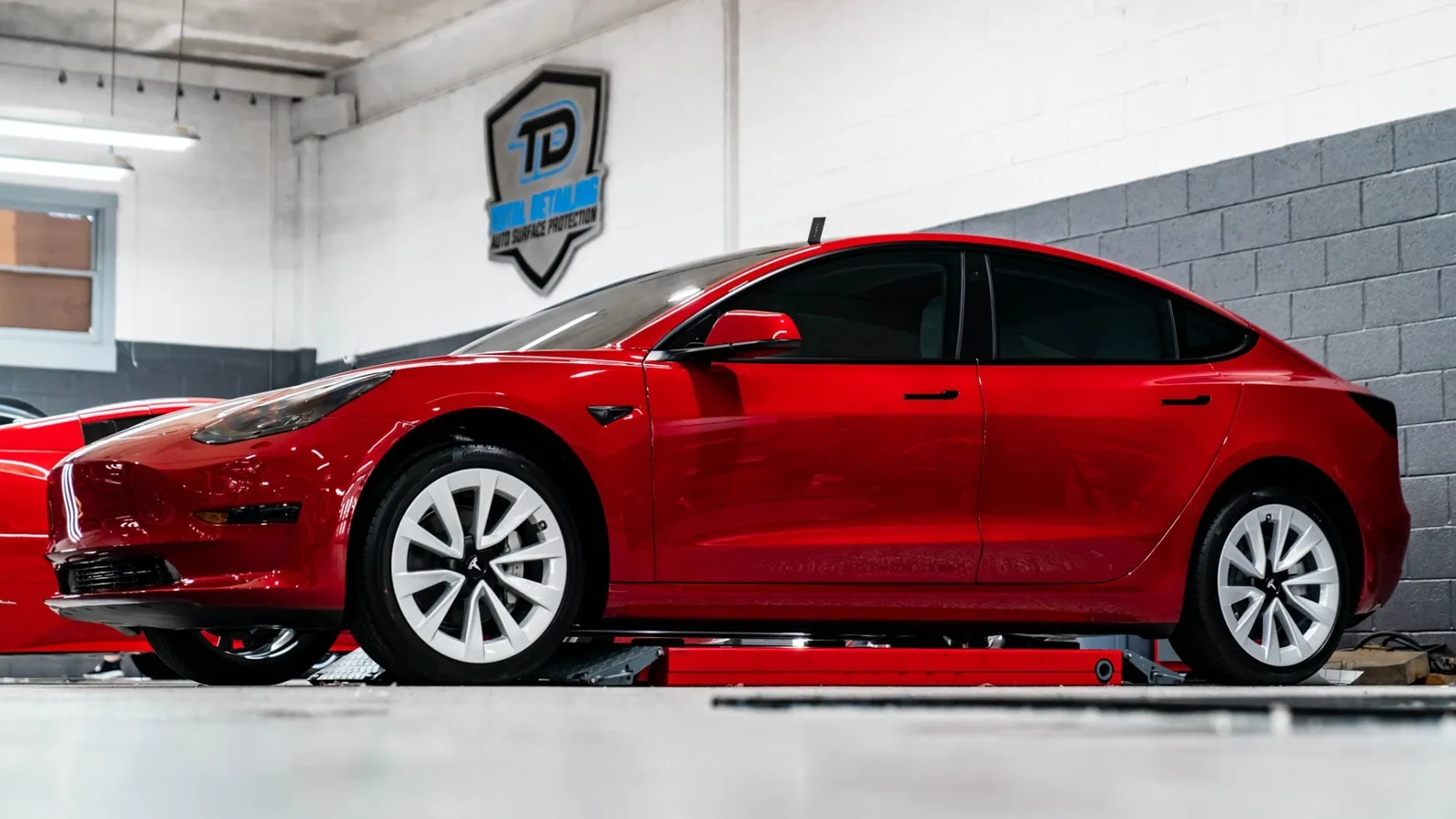
Model 3 in the shop
- 352 Google Reviews
- 5-Star Rated
- Featured in PPF Magazine
- Region's Only PeelClear (Peelable Paint Protection) Installer
Four things decide the number.
This is true whether you're quoting film, a coating, or what we spray. If a shop can't tell you where their number comes from, that's your answer.
A front end costs less than a whole car. That part is obvious. What's less obvious is that partial coverage puts a visible line somewhere on your car, and where that line falls changes the labor a lot.
Anything left on the paint gets sealed under the protection until it comes off. Correcting first is not an upsell, it's the difference between protecting a good finish and locking in a bad one. On a new car this is shorter. It's rarely zero.
A flat door is quick. A bumper with sensors, vents, and tight radiuses is not. Two cars with the same coverage tier can be hours apart in labor because of shape alone.
Hours and skill are most of the price of any protection job. A quote well under the going rate isn't a better deal on the same work. It's a different amount of work wearing the same name.
Our pricing is published rather than gated. You can see where things land before you talk to anyone.
We spray it on instead of
sticking it on.
PeelClear goes on in a paint booth, the same way automotive clear coat does. It cures into a layer 8 to 12 mil thick over your factory paint. That's as thick as or thicker than premium film.
There's no adhesive. It bonds mechanically, so there's no glue line against your paint and nothing to yellow or bake on. There are no cut edges either, because nothing was cut. It ends the way paint ends.
When it takes a hit, that's the layer doing its job. Scrapes and chips sand and buff back, or get spot resprayed on that panel. With film, damage usually means stripping and replacing that panel's section.
And when you're done with it, it peels off in sheets. Your factory paint is right there underneath.
- Self-healing, with the rest of the sentence. Light marring recovers with heat, from sun or warm water, the same way it does on film. It's not the aggressive self-healing premium films headline with, so we don't lead with it. Deeper damage sands and buffs back, or gets spot-resprayed. A ceramic coating on top stops most light marring from happening at all.
- The product is new. The chemistry isn't. It's the same two-part polyurethane family as the refinish clear coat body shops have sprayed for decades, and it carries a 20-year manufacturer warranty.
- Film still wins in one lane. Track cars and sustained gravel. If that's you, we'll say so.
Go Deeper
The full breakdown
● READING A QUOTEQuestions worth asking any shop
Questions worth asking any shop
You don't need to know the products to tell a serious quote from a thin one. You need to know which questions make a shop specific.
- What happens to the paint first? If the answer is "we wash it," ask again. Decontamination and correction are where the finish under the protection gets decided.
- Where do the edges go? On film, edges are the failure point. Ask whether they're wrapped or cut flush at the panel line, and ask to see one they finished.
- How long do you have the car? Real protection work takes days, not an afternoon. A same-day turnaround on a full job tells you something.
- What does the warranty actually cover? Yellowing? Lifting? Labor to redo it? And is it transferable if you sell?
Ask us the same four. If we get vague, hold us to it.
● CUT VERSUS SPRAYEDTwo ways to put a protective film on a car
Two ways to put a protective film on a car
The goal is simple. Your paint looks the same in five years as it does today. Getting there means putting a layer over it that takes the hits instead. There are two ways to do that, and the difference shows up years later, not on day one.
The common way is sheet film. It arrives on a roll, gets cut to each panel, and sticks down with adhesive. Done well it looks great leaving the shop. But it has to end somewhere, so every panel carries an edge, and that edge is where dirt collects and lifting starts.
The other way is spraying it. Ours goes on in a paint booth and cures into one continuous film across the whole panel. No seams, because nothing was cut. No adhesive, because it bonds mechanically. It still peels off in sheets years later, just without a fight and without taking clearcoat with it.
Sheet film is still the right call for a dedicated track car eating debris at speed. For nearly every Tesla we see, sprayed is the better answer, and it puts color on the table, which clear sheet can't do.
● TESLA SPECIFICSWhat Tesla owners actually ask us
What Tesla owners actually ask us
Teslas come through here constantly, and the questions repeat.
- The front end takes the beating. Nose, hood leading edge, mirror caps, and the rocker area behind the front wheels. That's where the highway finds you, and it's the same on a Model 3 as it is on a Model Y.
- Delivery condition varies. A new car is not automatically a perfect car. We look at what actually showed up before we quote the work, not at what a new car is supposed to look like.
- Sensors and cameras stay clear. We don't cover driver assistance hardware. Those areas get evaluated on your specific car during the consultation.
- Resale comes up a lot. Peelable matters here. Whatever we put on can come off before you sell, with the factory paint underneath the way it was.
● ALREADY HAVE FILMIf your Tesla is already wrapped in film
If your Tesla is already wrapped in film
You're still our customer. Nothing about this changed that.
We maintain film we installed, we'll look at lifting edges or staining and tell you honestly whether it's worth addressing, and we'll keep the rest of the car in shape around it. Ceramic coating goes over film fine, and that's often the cheapest way to make an aging film install easier to live with.
What we won't do is quote you new film. Bring the car in and we'll tell you what we'd actually do with it.